One data point to set the stage: 73% of e-commerce traffic comes from mobile (Shopify CRO Benchmarks 2026), yet the mobile web cart abandonment rate sits at 80-85% (Baymard Institute). Understanding whether a webview app can solve this problem for your business — or whether you need a different approach — is the first step toward spending your budget wisely.
What is a webview app and how does it work?
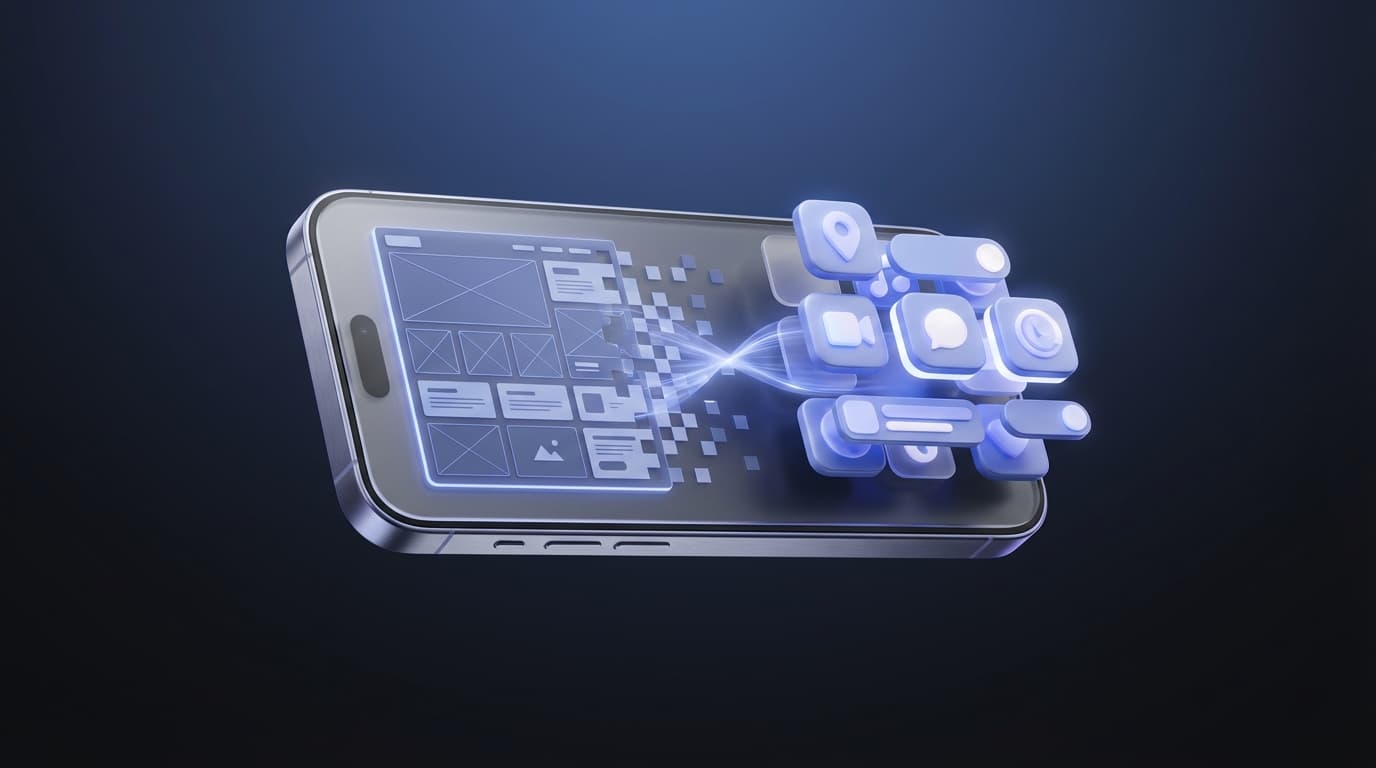
A webview app is a mobile application that contains a full-screen browser window inside it. When a user opens the app, they are actually browsing your website, rendered through the operating system's built-in engine: WebKit on iOS, the Chromium-based engine on Android.

In practice, the website gets "encapsulated" inside a native container. The container is a real app — it downloads from the store, has an icon on the home screen, and shows up in the app list — but the content it displays is your website, loaded in real time.
How it's built technically:
- Open-source frameworks like Apache Cordova or Capacitor, which create the native container with a built-in webview
- Online services that generate the wrapper automatically, with no coding required
- Minimal custom development in Swift (iOS) or Kotlin (Android), where the developer builds an app that loads a specific URL
The immediate advantage is obvious: any change to your website is automatically reflected in the app. Update a page, change a price, publish a new product — the app shows the updated version right away, with no need to release a store update.
The equally obvious limitation: the app is exactly as fast (or slow) as your website. There is no native optimization, no advanced caching, no logic running directly on the device.
When does a webview app make sense?
A webview app works well in specific scenarios. It is not a universal solution, but under certain conditions it is the most pragmatic and cost-effective choice.
Your website is already optimized for mobile
This is the fundamental prerequisite. If your site is responsive, fast on mobile, and delivers a good user experience on small screens, a webview app starts from a solid foundation. Users will not perceive a degraded experience because the content they see is already designed for mobile.
If, on the other hand, your site is not responsive or loads slowly on smartphones, a webview app amplifies problems instead of solving them.
The budget is limited but you want store presence
With a one-time investment between EUR 200 and EUR 2,000 (or from EUR 40/month with platforms like Appo that add native features such as push notifications), you can have an app published on the App Store and Google Play. For an SMB or a professional who wants an icon on their customers' home screens without investing EUR 15,000+, this is a sensible tradeoff.
Content changes frequently
Blogs, magazines, news portals, catalogs with frequent updates: in all these cases, automatic syncing between website and app is a massive advantage. You do not need to release a store update every time you publish a new article or update a price list. Content updates in real time.
You want to test the market before committing
If you are considering whether your users would actually use an app but do not want to risk tens of thousands of euros, a webview app is a perfect MVP (Minimum Viable Product). It lets you measure downloads, retention, and real engagement — concrete data to base your next decision on.
You need to go live fast
Where custom development takes 3-6 months, a webview app can be ready in a matter of days. If you have a deadline, an event, or an upcoming launch, the webview's time-to-market is unbeatable.
When does a webview app NOT make sense?
There are scenarios where a webview app is the wrong choice, regardless of available budget. Recognizing them early saves you frustration, store rejections, and a user experience that damages your brand.
You need advanced native features
Real-time camera access, augmented reality, motion sensors, Bluetooth, NFC, deep OS integration: all of this requires native code. The webview has no direct access to device hardware (or very limited access). If your project depends on these capabilities, you need a native or hybrid app.
Performance is critical
Gaming, apps with complex animations, interfaces that must respond in milliseconds: the webview introduces a layer of latency that native rendering does not have. Every interaction passes through the browser engine, resulting in a less fluid experience compared to native code.
The app must work offline
A webview app loads content from the web. Without a connection, the user sees a blank screen or an error. Caching and splash screens can partially mitigate the problem, but for truly offline-first experiences — navigation apps, productivity tools that must work without a network, field operator apps — the webview is not enough.
Strict security requirements
Banking apps, healthcare applications, systems with advanced biometric authentication: these contexts require native components with OS-level encryption, secure enclave, and specific certifications. The webview does not offer the same level of protection.
You want a premium user experience
If your brand relies on user experience as a differentiator — polished animations, fluid transitions, custom gestures, an interface that "feels" native — the webview will not reach that level of refinement. Experienced users notice the difference between a native app and a website inside a container.
What are the most common use cases?
Let us get practical. Here is a decision matrix covering the most frequent scenarios, with a clear assessment for each one.
- E-commerce (Shopify, WooCommerce, other) — YES. The website is already optimized for mobile sales. Appo from EUR 40/month adds push notifications and managed publishing. Recommended approach: an automated platform like Appo.
- Blog / magazine — YES. Text and multimedia content is a perfect fit for webview. Push notifications increase returning readers. Recommended approach: webview with push notifications.
- Company / institutional website — YES. Store presence, home screen icon, customer loyalty. Primarily informational content. Recommended approach: automated platform.
- MVP / market test — YES. Quick validation before investing EUR 15,000+ in custom development. Real data on downloads and usage. Recommended approach: webview or automated platform.
- Internal company app — YES. Employee portals, documentation, internal tools. No need for public store publishing. Recommended approach: simple webview.
- Promotional landing pages — YES. Temporary campaigns, events, product launches. The app is short-lived but you need a fast presence. Recommended approach: basic webview wrapper.
- Gaming — NO. Real-time performance, graphics rendering, game physics. The webview cannot handle it. Recommended approach: native app (Unity, Unreal).
- Banking / fintech app — NO. Security requirements, hardware encryption, certifications. The webview is not sufficient. Recommended approach: native app with security components.
- Augmented reality app — NO. Direct camera access, sensors, GPU. Requires ARKit (iOS) or ARCore (Android). Recommended approach: native app.
- Fitness / health app — NO. Integration with sensors, HealthKit, Google Fit, continuous background monitoring. Recommended approach: native or hybrid app.
A data point for context: mobile apps convert on average 3 times more than mobile web (source: MobiLoud/Tapcart). For the e-commerce use cases listed above, this means that even a well-built webview app — with push notifications and an optimized mobile experience — can deliver measurable returns compared to a mobile website alone.
E-commerce: the primary use case
E-commerce deserves a deeper look because it is the scenario where a webview app (especially one enhanced with native components) delivers the most obvious results.
The numbers:
- 73% of e-commerce traffic comes from mobile (Shopify CRO Benchmarks 2026)
- 80-85% cart abandonment on mobile web (Baymard Institute)
- Apps reduce abandonment to 20-30% thanks to simplified checkout, persistent login, and cart recovery push notifications
- Push notification conversion rate: 4.4% (PushPushGo), higher than email and social
For an online store running on WooCommerce, Shopify, Wix, or any other platform, turning the website into an app with a solution like Appo (from EUR 40/month) means having a dedicated mobile channel with native push notifications, managed store publishing, and automatic updates every time the catalog changes.
Blogs and magazines: distribution and loyalty
For blogs, a webview app solves a specific problem: content distribution. Social platforms are progressively cutting organic reach, and email marketing has open rates of 15-20%. Push notifications, built into the app, reach users directly on their phone's home screen with a significantly higher open rate.
Every new article you publish can trigger a push notification that brings the reader back into the app. This creates a loyalty loop that social media and email struggle to replicate with the same immediacy.
Does Apple accept webview apps on the App Store?
This is the question that causes the most anxiety, and for good reason. Apple is known for its strict guidelines, and section 4.2 of the App Store Review Guidelines is explicit: apps that are "essentially a repackaged website" may be rejected.
But the reality is more nuanced than a simple "yes or no."
Apple accepts webview apps provided that:
- They offer functionality beyond simply displaying the website
- They include push notifications, widgets, or other native integrations
- They provide an experience optimized for the device (not a copy-paste of the desktop site)
- They have a proper icon, splash screen, and design consistent with iOS standards
Apple rejects webview apps when:
- The app is a simple wrapper with no added value over opening the site in Safari
- There are no native features (no push, no system integration)
- The experience is identical to or worse than the mobile website
- The app appears to be an attempt to game the system for store visibility
The key factor is added value. If your app offers push notifications, an optimized browsing experience, and quick access from the home screen with a polished interface, Apple accepts it. If it is just a link to the site, it gets rejected.
With platforms like Appo, publishing is handled by experts who know Apple's guidelines inside and out. The team understands the requirements, prepares the app to comply, and manages the entire review process. This eliminates the risk of unexpected rejections and costly iterations.
On Google Play, the guidelines are less restrictive. Webview apps are generally accepted as long as they function correctly and do not violate basic policies (malware, prohibited content, etc.). The review process is also faster — hours rather than days.

What are the alternatives to a webview?
The webview is not the only option for anyone who wants a mobile app without building from scratch. Here are the three main alternatives, with pros and cons for each.
Progressive Web App (PWA)
A PWA is a website that behaves "almost" like an app. It can be installed on the home screen, works partially offline thanks to service workers, and can receive push notifications (with limitations on iOS).
Advantages: zero or near-zero cost (it is the website itself), no store review process, instant updates.
Limitations: on iOS, PWAs face significant restrictions — Apple limits push notifications, offline caching, and access to native APIs. They do not appear on the App Store, which means zero organic store visibility and no chance of being found through App Store search.
When it makes sense: as a complement to the website, not as a substitute for a native app. A PWA can coexist alongside a webview app or a native app.
Hybrid apps (React Native, Flutter)
Hybrid frameworks allow you to write a single codebase (JavaScript for React Native, Dart for Flutter) that compiles into native apps for iOS and Android. The result is an app with near-native performance and access to hardware features.
Advantages: performance superior to webview, access to native APIs (push, camera, GPS), a single codebase for both platforms.
Limitations: requires a specialized developer, costs approach native development (EUR 10,000-30,000), timelines run 2-4 months. This is not a "ready-to-use" solution.
When it makes sense: when you need native features the webview does not support, but the budget does not allow for two separate native apps (iOS + Android).
Native app (Swift/Kotlin)
Fully native development — Swift for iOS, Kotlin for Android — is the choice that offers maximum control, the best performance, and complete access to every device capability.
Advantages: optimal performance, premium user experience, access to every OS API, maximum flexibility.
Limitations: high cost (EUR 15,000-50,000+), long timelines (3-6 months), need for two separate teams (or a cross-platform team), expensive maintenance (EUR 500-2,000/month).
When it makes sense: for apps that are the product itself (not an additional channel), enterprise projects, and use cases that require extreme performance or advanced hardware features.
Automated platforms: the middle ground
Platforms like Appo sit exactly between the webview and the hybrid app. They start from your existing website but add native components — push notifications, optimized navigation, managed publishing — with no development required. The cost is a monthly subscription (from EUR 40/month with Appo), not a six-figure project.
For most online stores and SMBs, this is the choice with the best balance of cost, speed, and results.
Frequently asked questions
Does Apple accept webview apps?
Yes, provided they offer value beyond the website: push notifications, home screen icon, optimized experience. A simple wrapper with no added value may be rejected under section 4.2 of the App Store guidelines. With Appo, publishing is handled by experts who know Apple's guidelines and ensure the app meets all requirements before submitting for review.
How much does a webview app cost?
From EUR 200 to EUR 1,000 for a basic wrapper built with frameworks like Cordova or online services, up to EUR 2,000 for more polished solutions with custom design. Alternatively, platforms like Appo start at EUR 40/month and include managed store publishing, push notifications, and automatic updates — features that a basic wrapper does not offer.
Does a webview app work offline?
To a limited extent. The main content requires an internet connection because it is loaded from the website in real time. Elements like the splash screen, icon, and some cached resources work offline, but actual navigation does not. For fully offline experiences — productivity apps, field operator tools, navigation without a network — you need a native or hybrid app with local storage.
Can I add push notifications to a webview?
Yes, but not with a basic wrapper. You need native components that handle Apple Push Notification Service (APNs) for iOS and Firebase Cloud Messaging (FCM) for Android. Platforms like Appo integrate them natively: the Starter plan includes 500 push notifications per month, the Business plan offers unlimited push. The push notification conversion rate is 4.4% (source: PushPushGo), higher than email marketing and social.
Is a webview suitable for an online store?
Yes, it is one of the best use cases — as long as the website is already optimized for mobile. 73% of e-commerce traffic comes from mobile (source: Shopify CRO Benchmarks 2026), and mobile apps reduce the cart abandonment rate from 80-85% on mobile web to 20-30% (source: Baymard Institute). With platforms like Appo, which add native push notifications and managed publishing, the transition from website to app is seamless and the return measurable.
What is the difference between a webview app and a PWA?
A webview app is a real application, downloadable from the stores (App Store, Google Play). A PWA (Progressive Web App) is an advanced website that installs on the home screen directly from the browser. A webview app has store visibility, can receive push notifications without restrictions, and has a native icon. A PWA does not appear on the stores, has limitations on iOS (reduced push, limited cache), and does not deliver the same perception of a "real app" to the user.
How long does it take to create a webview app?
With a basic wrapper, 1 to 5 days for technical setup, plus 1-2 weeks for store review. With platforms like Appo, the app is ready within 48 hours of setup, including publishing on the App Store and Google Play. Custom development (native or hybrid app) takes 3-6 months.